
2012 - Yang, Hou - Membranes in lithium ion batterie - Membranes
Intelligent Sensor Technology, Inc. 미각센서 제품 동영상
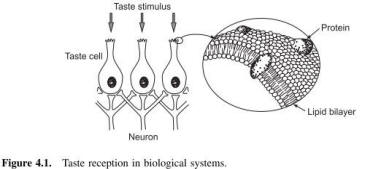
Taste Sensor [미각 센서]: Five basic flavors: sour, bitter, sweet, salty, and umami, or savory. TR type,
10 Recent advances in electronic tongues
2017 - Podrazka et al. - Electronic tongue-A tool for all tastes - Biosensors
| pH and ORP Learning Handbook | ||||
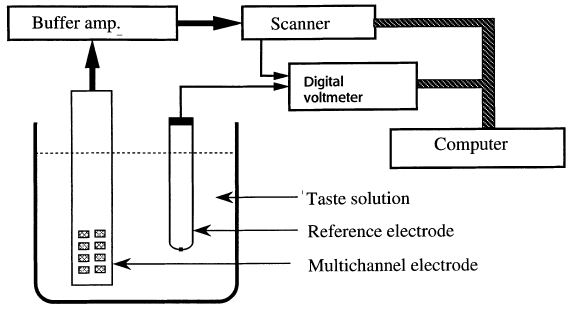
| 1998 | Electronic Sensing of Tastes |
 |
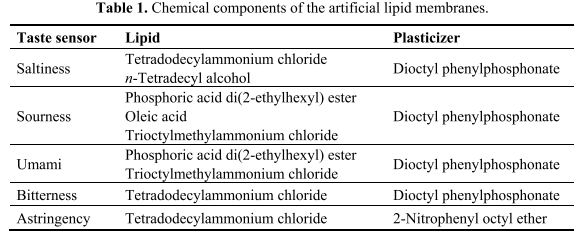
Each lipid was mixed in
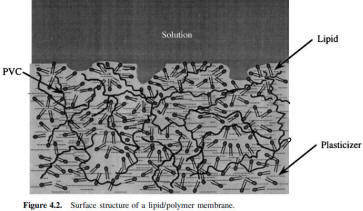
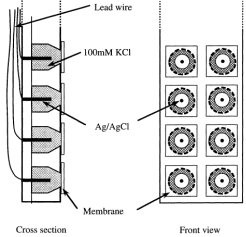
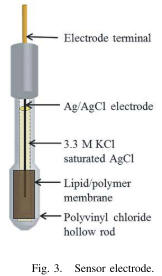
a test tube with polyvinyl chloride (PVC), and a plasticizer (dioctyl phenylphosphonate), which were dissolved in tetrahydrofuran. Successively, the mixture was dried in a glass plate, which was placed on a hot plate controlled at ca. 30 C. The lipid/polymer membrane thus prepared was a transparent, colorless and soft film with ca. 200 mm thickness. Lipid/polymer membranes were fitted on a multi channel electrode. 멤브레인을 판에 붙였고 판은 basal acrylic board of 2 mm thickness. 그리고 1cm 아크릴 보드에 콘 모양 구멍을 형성하고 KCl로 채움. Ag/AgCl전극이 들어 있는 구조.
|
 |
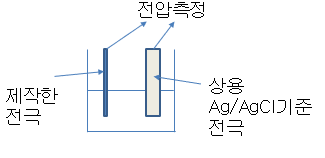
| Ag/AgCl 기준전극 |
||AgCl(salt),KCl(xF)|Ag Half reaction AgCl + e- = Ag + Cl- E°= +0.2223V
제작 : Ag wire에 AgCl층을 plating à KCl에 immerse Internal reference electrode로 많이 사용 In vivo에서도 이용, 275℃까지 안정 |
|||
| Hydrogen sensor 동영상 |
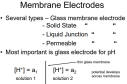
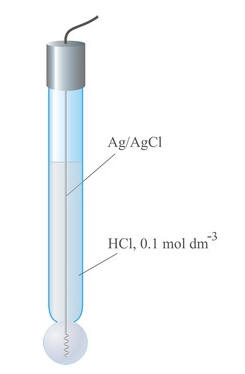
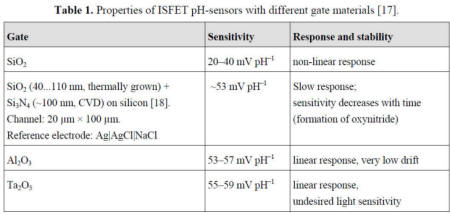
Glass electrode is a hydrogen-ion responsive electrode usually consisting of a bulb, or other suitable form, of special glass attached to a stem of high resistance glass complete with internal reference electrode and internal filling solution system. Glass electrode is also available for the measurement of sodium ions. The glass electrode, which consists of a thin wall glass bulb, has an extremely high electrical resistance. The membrane of a typical glass electrode (with a thickness of 0.03 mm to 0.1 mm) has an electrical resistance of 30 MΩ to 600 MΩ. The surface of a glass membrane must be hydrated before it will function as a pH electrode. When a glass surface is immersed in an aqueous solution then a thin solvated layer (gel layer) is formed on the glass surface in which the glass structure is softer. This applies to both the outside and inside of the glass membrane.
|
 |
||
| A glass electrode (Fig. 1) is actually a device, not an electrode in an electrochemical sense of the word. It consists of a glass bulb membrane, which gives it its name and an electrically insulating tubular body, which separates an internal solution and a silver/silver chloride electrode from the studied solution. | the glass surface in contact with solution becomes hydrated as water enters a short distance into the crystal lattice and causes it to swell. The “interior” of the glass remains dry. Some of the metal ions within the glass close to the solution boundary are able to diffuse into the solution, and some H+ ions are able to charge pair with oxygen near the glass surface. In this way, ion exchange equilibrium is established between the fixed negative sites on the glass surface and H+ , with an increasing number of charge pairs with H+ occurring as its activity in the contacting solution increases. This equilibrium can be expressed by H+/-O-Si- Ù H+ + - O-Siwhere H+/-O-Si- and - O-Si- represent oxygen sites at the glass membrane ion paired with H+ and unpaired, respectively. | 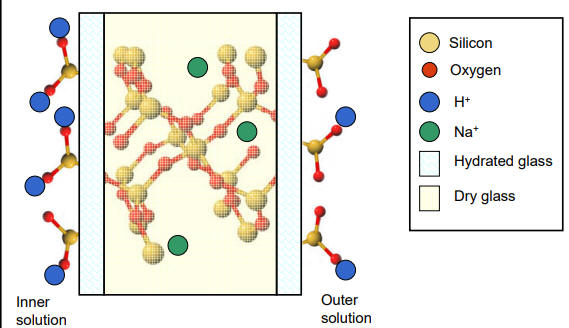 |
||
| 1901 | F. Haber 가 얇은 유리 membrane 의 전압이 용액의 산도에 따라 변하는 것을 관찰 | |||
| 1906 | M. Cremer 얇은 유리 membrane에서 용액 pH에 따른 potential 변화 측정 | 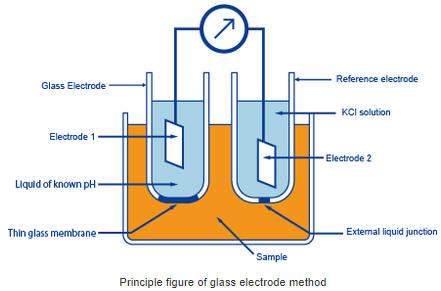 |
||
| 1909 | ||||
| 1933 |
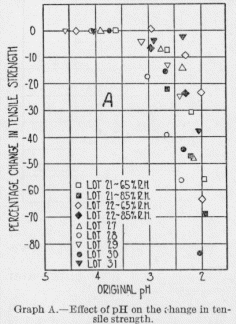
Influence of some sulphur containing tanning materials on the
deterioration of vegetable· tanned leathers by sulphuric acid |
가죽제조에서 산도가 가죽의 질에 영향을 준다는
것을 보임 가죽의 tensile strength 의 변화를 비교. The use of synthetic tanning material, sulphite cellulose, and sulphited extracts in conjunction with vegetable tannins did not cause any appreciable deterioration of the leather. |
 |
|
| 1934 | Glass and Other Electrodes for Measuring pH Values of Very Dilute Buffers and of Distilled Water | The glass electrode and isohydric indicator methods give approximately the same pH values in very dilute buffers and distilled water. | 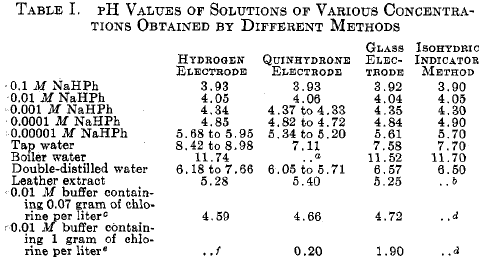 |
|
| 1935 | Method for measuring the pH of leather using a simple glass electrode assembly | The glass electrode was found to be more rapid and to require less attention than the hydrogen electrode. | ||
| 1967 Ca sensor Orion Research Incorporated |
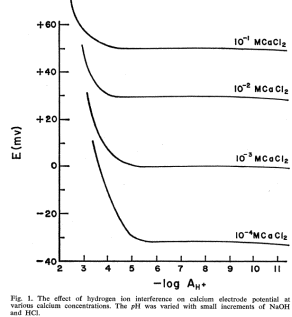
Calcium-Selective Electrode with Liquid Ion Exchanger Membrane: Ref:: saturated KCl-calomel Electrode: Ca |
Na 등 여러 cation들이 존재할 때 Ca
이온만 선택적으로 측정.
|
 |
|
| 1970 Technische Hogeschool, Netherlands |
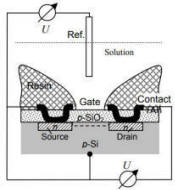
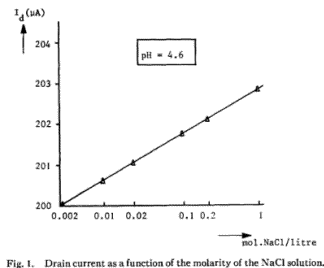
Development of an Ion-Sensitive Solid-State Device for Neurophysiological Measurements | MOSFET의 채널길이 100 um, 폭 1mm, 게이트 절연막 두께
200 nm. 소스/드레인/하부 전극 등이 용액과 접촉하지 않게 epoxy resin 으로 감쌈. Vds=0.1V, 드레인 전류 path 에 10 옴 저항을 달고 10 옴 저항의 전압을 측정하여 전류를 구함(i=V/R) pH를 일정하게 하고 Na+ 이온 농도 증가시키며 전류 측정. |
  |
 |
| 1970 U. of Wales
|
A Calcium-sensitive Electrode Based on a L'iquid Ion Exchanger in a
Poly(viny1 chloride) Matrix
Membrane: ion-exchanger + PVC Didecylphosphoric acid + dioctylphenylphosphonate Ref.: Ag-AgCl/CaCl Electrode: Ca
|
Ca 이온을 체크 할 수 있는 PVC ion
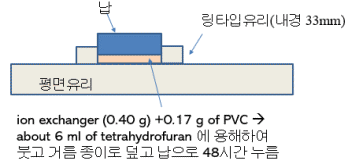
exchanger membrane 의 제조. 1. Ion exchanger 제조-Didecylphosphoric acid (0.3785 g) was dissolved in 5ml of dioctylphenylphosphonate to give a 0.2 M solution. This ion exchanger was converted into the calcium form by shaking it with six 10-ml portions of M aqueous calcium chloride and drying over solid calcium chloride before membrane preparation. 2.Membrane preparation- The ion exchanger (0.40 g), 0.17 g of PVC --> 약 6 ml of tetrahydrofuran 에 용해 후 아래 그림과 같이 membrane 만듬. 유리에서 떼어 내면 약 0.5 mm 두께 membrane이 얻어짐
|
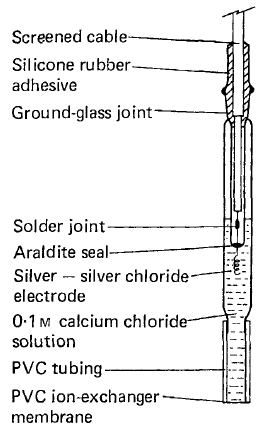 제조된 membrane을 6mm 직경으로 자르고 tetrahydrofuran 용 용해된 PVC를 접착제로 외경 6mm PVC 튜브에 붙임. |
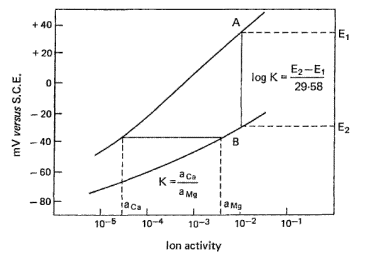 몰농도에 따른 전압변화. 기준cell 은 크로멜 타입사용. K 는 selectivity. A는 Ca, B 는 Mg, 1974 |
| 1974 State U. of NewYork
|
PHOSPHOLIPID FLIP-FLOP AND THE DISTRIBUTION OF SURFACE CHARGES IN EXCITABLE MEMBRANES STUART |
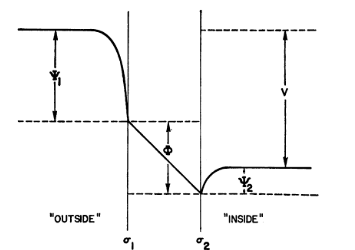 |
||
| 1980 U. of Wales |
Divalent (Water Hardness) Ion-selective Electrodes Based on Poly(viny1 Chloride) and Poly(methy1 Acrylate) Matrix Membranes |
제작된 Ion exchanger를 PVC나 PMA 에 녹여 membrane 을
제작. Calcium bis(didecy1phosphate) (0.02 g) + didecylphosphoric acid (0.02 g) 을 PMA 에 용해 하여 membrane 제작.
|
||
| 1985 UWIST, UK
|
Model studies on multiple channel analysis of free magnesium,
calcium, sodium, and potassium at physiological conc Membrane |
|||
| 1994 Kyusyu Univ. |
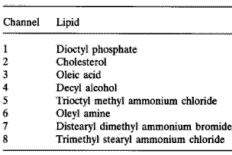
Multichannel taste sensor using electric potential changes in lipid membranes Membrane: lipid+PVC+DOPP 150 um Ref.: Ag/AgCl with saturated KCl
|
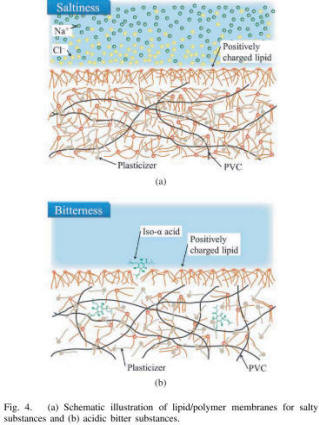
In biological taste
reception, the lipids in the biological membrane are suggested to
play an important role (Kurihara et al., 1986). Lipid membranes have
been investigated in detail as a candidate of transducers of the
taste sensor so far (Iiyama et al., 1986, 1987, 1989; Toko et al.,
1986, 1987; Hayashi et al., 1989).
|
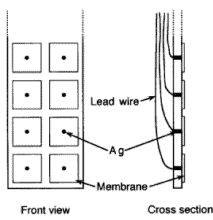 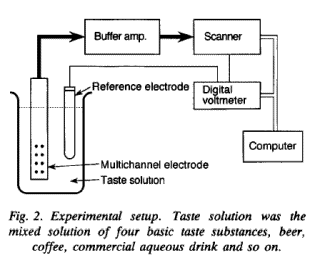 각 전극에 다른 재료의 lipid 를 사용 poly vinyl chloride (PVC) and dioctyl phenylphosphonate (DOPP, plasticizer) 와 같이 casting 해서 사용. 150 um두께의 투명 유연 membrane을 얻음. |
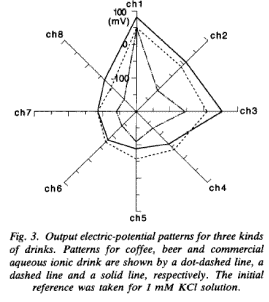 커피, 맥주, 이온 음료에 대한 각 채널별 전압 |
| 1998 Film type Ag-AgCl 표준 전극 U. of Southampton |
Thick film silver–silver chloride reference electrodes | Ag/AgCl 기준 전극을 사파이어 기판(5cm x 5cm)
위에 스크린 인쇄로 제작
제작된 샘플과 상용 기준 전극을 순수에 담그고 KCl용액을 떨어뜨려 Cl 농도를 변화시키며 전압 측정
|
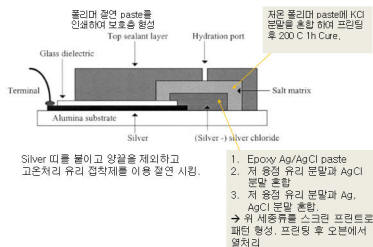 |
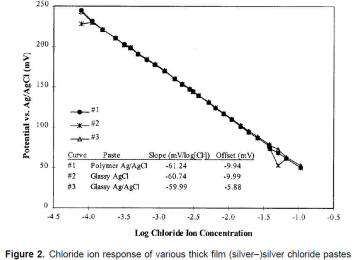 |
| 2006 electrode bodies (type IS 561, made by Moeller AG) filled with 0.1M KCl solution. Gdansk U. ofTechnology
|
On the possibility of using liquid or lipid, lipid like-polymer
membrane systems as taste sensor Ref.: Ag/AgCl/Cl− (3MKCl) |
The solution of PVC, lipid material and plasticizer dissolved in THF was poured into a glass ring attached to a glass plate. Then the solvent was allowed to evaporate and polymer film was separated from the plate as a transparent and colorless membrane. | 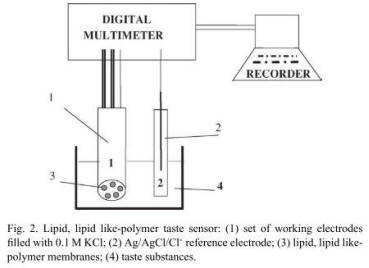 |
|
| 2006 IIT, India |
Polyvinyl alcohol A taste sensing material
Membrane: PVA+MA Ref.: Ag/AgCl electrode enclosed in a glass tube filled with 100mM KCl and 1% agar. |
PVA(10 g) and Maleic acid (MA)(4.5 g) were dissolved in 100 ml water at room temperature. The viscous homogenous solution of PVA and MA was cast on a petridish to prepare a mem- brane. After slowly drying in air, the membrane was heated at 70 ◦C for 2 h for esterification of some OH groups of PVA with MA. Then MA cross-linked PVA was phosphorylated by refluxing with POCl3 in THF at 70 ◦C for 1–4 h by using triethylamine as catalyst. Finally the phosphorylated membrane was washed with distilled water and dried. | 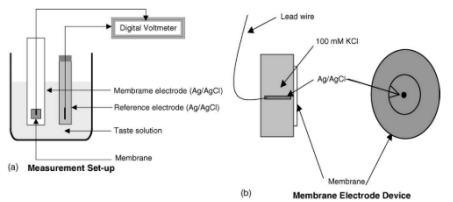 |
|
| 2007 Warsaw U. Poland |
Sensor arrays for liquid sensing - Electronic tongue systems - Analyst | |||
| 2010 U. Kyusu |
Advanced taste sensors based on artificial lipids with global selectivity to basic taste qualities | 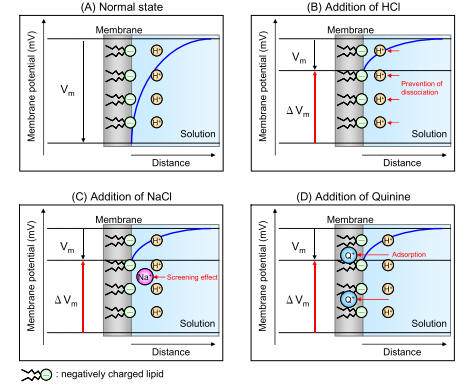 |
||
| 2011 U. Kyushu |
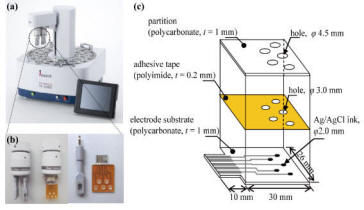
Development and Evaluation of a Miniaturized Taste Sensor Chip | 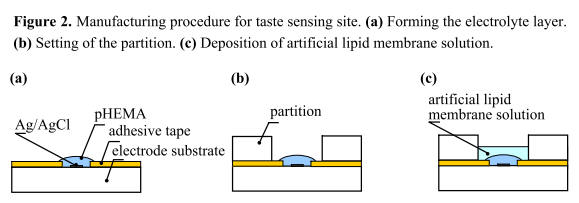 PC 위에 Ti/Ag 패턴(Sputtering & Photolithograpy, the silver and titanium were etched in a mixed solution containing 10 wt% NH3 and 30 wt% H2O2, using the patterned resist as a mask. The substrate was washed in ethanol.). Ag/AgCl ink (Ag/AgCl Ink for reference electrode, BAS, Japan) was applied to the electrode. A poly(hydroxyethyl methacrylate) hydrogel (pHEMA) was polymerized by irradiation with UV light as the electrolyte layer. In the first step, 4 μL of a HEMA mixture solution consisting of 60 wt% hydroxyethyl methacrylate, 38 wt% ethylene glycol, 1 wt% dimethoxy-2-phenylacethophenone, and 1 wt% tetraethylene glycol dimethacrylate was dropped onto the electrode with the adhesive tape and was polymerized by UV light (2–3 mW/cm2) for 4 min [Figure 2(a)]. Twenty microliters of the artificial lipid membrane solution was
deposited twice on the pHEMA layer of the sensing site with the
partition, and then desiccated at room temperature for 10 hours
[Figure 2(b,c)]. Finally, the sensor chip was conditioned for 1 day
in a solution of 30 mM KCl and 0.3 mM tartaric acid before
measurement. |
|
|
| 2013
|
Electronic tongues-a review - IEEE Sensors Journal |
A lipid/polymer membrane comprising a lipid, polyvinyl chloride, and
a plasticizer is used for the stage of receiving taste substances,
the key technology of the taste sensor. The thickness of the
membrane is about 200 μm and the membrane can be used about 3,000
times. The commercialized taste sensor, i.e., the taste sens-
|
|
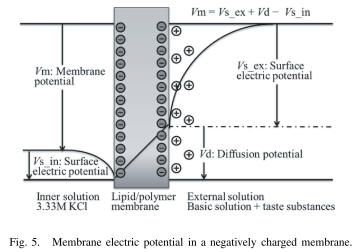 멤브레인 주변에서의 포텐셜 |
| 2014
Kyushu, Toko |
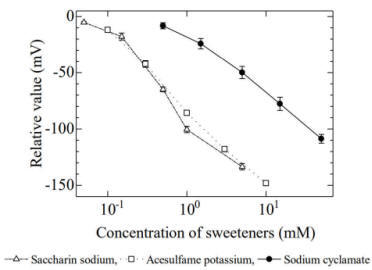
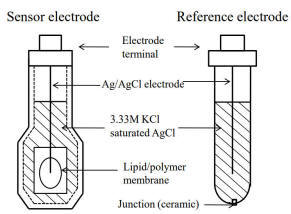
Yasuura et al. - Development of sweetness sensor with selectivity to negatively charged high-potency sweeteners |
 |
 |
|
| 2017 Kyushu, Toko |
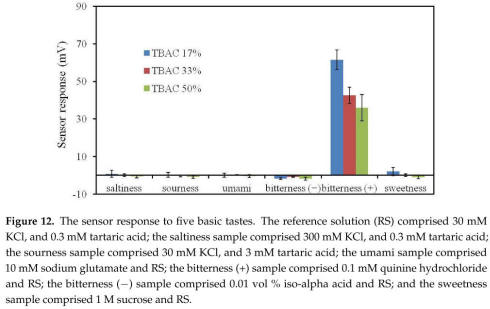
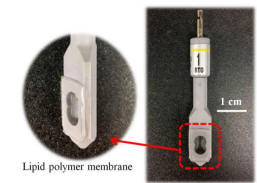
Wu et al. - Improved durability and sensitivity of bitterness-sensing membrane for medicines - Sensors |
 |
 |
|
| 2018 Kyushu, Toko |
Tahara, Toko - Development of Taste Sensor with High Selectivity and Sensitivity - ALLSENSORS |
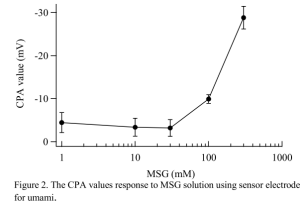 |
||